Minggu, 21 Juli 2013

Verdict in Indonesia: Government must return ancestral lands


The indigenous peoples of Indonesia and its advocacy group, AMAN, have scored a great success: the Constitutional Court ruled that the government must recognize the land rights of forest dwellers. It may no longer class their customary forests as “state forest areas” and lease them to loggers or plantation operators.

It was a long battle for the alliance of indigenous peoples in Indonesia (AMAN). On May 16, 2013, the Indonesian state news agency quoted Justice Muhammad Alim’s ruling as follows: “Members of customary societies have the right to clear forests belonging to them and use the land to fulfill their personal and family needs. The rights of indigenous communities will not be eradicated, as long as they are protected under Article 18b of the Constitution.”

The Constitutional Court’s landmark ruling is an important step toward recognizing the rights of Indonesia’s 40 million indigenous inhabitants, who have used the forests sustainably for generations.

The ruling bars the government from opening the land to exploitation by designating indigenous land as “state forest” and granting lucrative concessions to influential companies.

The Indonesian Ministry of Forestry has recognized that the rainforest dwellers have practiced sound conservation for millennia using knowledge handed down from generation to generation. Sumarto, a spokesman for the Ministry of Forestry, told the Jakarta Globe that “the Ministry of Forestry considers indigenous peoples living in a certain area as being part of the forest itself. They cannot be separated. Custom-based societies are on the front lines of forest management.”

The environmental organization Walhi is now urging regional governments to draft bylaws to specify which areas belong to indigenous societies. This is the best possible option for protecting Indonesia’s rainforests. Walhi activist Zenzi Suhadi: “In many cases, the customary forests of the indigenous communities are better managed than protected forests owned by the government.”

Rainforest Rescue has supported its Indonesian partner organizations for years in the struggle for indigenous land rights and preservation of tropical forests.

source:

http://www.rainforest-rescue.org/achievements/5126/verdict-in-indonesia-government-must-return-ancestral-lands

http://www.thejakartaglobe.com/news/constitutional-court-annuls-government-ownership-of-customary-forests/

http://www.redd-monitor.org/2013/05/17/indonesias-constitutional-court-returns-customary-forests-to-indigenous-peoples/#more-13950

Jumat, 19 Juli 2013

Most Endangered Orangutan Population Found Hidden

Orangutan seen wandering Hampapak Island, in the middle of the River
by SARAWAK, KOMPAS.com ,  as many as 200 individual orangutan subspecies Pongo pygmaeus pgymaeus found in Borneo region, precisely in the area of ​​140 square kilometers, Batang Ai National Park, Sarawak, Malaysia.

Orangutan orangutan species are known to be the most rare. Its population is now living up to 3000-4500. A total of 2,000 of whom are estimated to live in Batang Ai National Park and Sanctuary Lanjak Entimau, Malaysia.

Previously unknown population was discovered through research at the Wildlife Conservation Society last February 2013. They found 995 orangutan nests, including nests "fresh" which indicates that orangutans use these areas.

Nests can indeed indicate the existence of orangutans in a region. Previous research in Kalimantan, Indonesia, showed that orangutans are able to bend and weave twigs that can be used as a "home".

"They just bend. They can live in it and then you can view it as archaeological artifacts," says Roland Ennos from the University of Manchester in their study, published in the Proceedings of the National Academy of Sciences last year.

LiveScience reported on Thursday (04/11/2013), related to the discovery of this new population of orangutans, Malaysian Government plans to increase the protection of the population in the national park where it was found.

Rabu, 17 Juli 2013

Pictures old of Central Kalimantan (1) : South Barito Regency

Pictures old of Central Kalimantan (1) : South Barito Regency

Any pictures that important relic (Age Netherlands - 1990) then located in Central Kalimantan.

Let more neat old photographs classified according to their respective regions (alphabetical order).

South Barito Regency : by albert alang Foto-foto Kalteng jaman dulu.

A KNIL military campment on a river in Borneo. 1890-1900

Buntok, one of the biggest villages on the Barito. 1936


Het gouvernements S.S. Selaton op de rivier Barito, Borneo. before 1917


Mengkatip  This church was dedicated on 16th March1930


On the street in Mengkatip 1923


Pelabuhan Mengkatip di sungai Barito 1924


The congregation in Mengkatip with the missionary Hamp, 1908


Borneo bull Camera Caught

by Editor : Yunanto Wiji Utomo

JAKARTA, KOMPAS.com - forest conservation organization, Yayasan Orangutan Indonesia, prove the existence of a bull in the wilds Belantikan Kalimantan, Central Kalimantan. Recent evidence is a result of the presence of surveillance cameras that captured the protected fauna are active in the region nonkonservasi.

"These findings should awaken us all about the importance of protecting forest ecosystems outside the conservation area," said Eddy Santoso, Executive Director of Yayasan Orangutan Indonesia (Yayorin), Sunday (14/07/2013), of Pangkalanbun, Central Kalimantan.

Visually proving the existence of a bull Kalimantan is the first time. Previous years, the bull only known to exist of the footprints and droppings on Hulu Belantikan.

Eddy explained, it seeks to assure the presence of Borneo banteng (Bos javanicus lowi) by installing surveillance cameras (camera traps). Activities carried out during the period 2012-2013 with funding Yayorin U.S. Fish and Wildlife Services in Belantikan.

"From some of the shots captured photo images in groups or solitary bull," said Eddy. Herd of bison observed in the mineral region in the middle of a forest called politeness (salt lick). Politeness to the indigenous territories.

Among the 25 who recorded politeness, two great politeness great potential as a herd bull, ie politeness politeness salinity and sandy. "It strengthens the evidence no bull population in Hulu Belantikan Kalimantan, Lamandau district," said Imam Sapari, researchers Yayorin.

Admittedly, the findings are very preliminary and challenge scientists, researchers, and conservationists to proceed with a comprehensive review. "There is still ongoing research is needed, especially for population monitoring, well socialized to people familiar with the typical wildlife Belantikan are reserved," said M Yunus, researchers Yayorin.
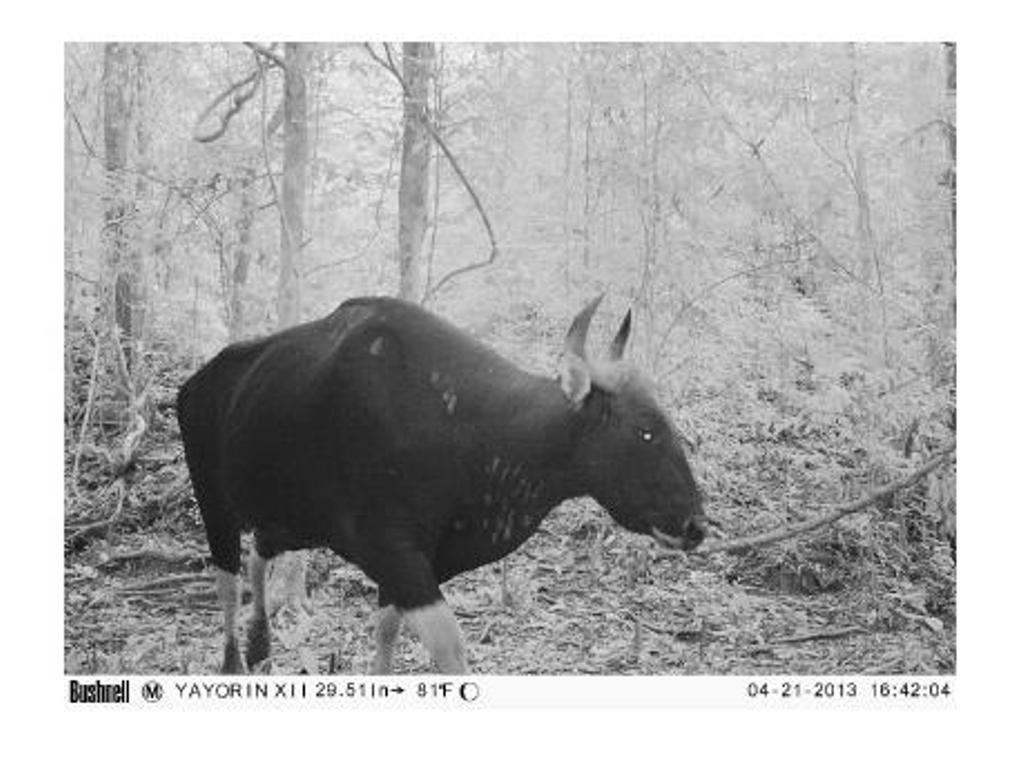

Kalimantan bull caught by a camera mounted researchers Yayasan Orangutan Indonesia, in the upstream Belantikan, Lamandau, Central Kalimantan, some time ago. The findings are outside the conservation area. It is a reminder of the importance of protecting outside of protected areas. | Yayorin


Outside the protection area

According to Eddy, the key protection is the involvement of the owner of the bull Kalimantan concession license for utilization of timber forest products (IUPHHK) in the protection of endangered species and activities outside the protected conservation area.

"The next challenge, finding a combination of forest concession permits whose location is located in areas that are very important for the animals that have protected status, and need to increase cooperation, sense of responsibility, and a firm commitment to implement area management, habitat, and wildlife sustainable area of ​​operations and supporting livelihoods of local communities, "says Eddy.

Kalimantan bull findings indicate that many actually protected fauna living outside conservation areas. Previous studies indicated through traffic dispersion and wildlife such as orangutans, Sumatran tigers, and Sumatran elephants.

Hulu Belantikan region is lowland forest remaining in Central Kalimantan and is currently a limited production forest timber and mining companies. Belantikan landscape of the region began to Arut Belantikan Perai and Bukit Bukit cavity in West Kalimantan area of ​​approximately 500,000 hectares.

Belantikan has a population of orangutans (Pongo pygmaeus wurmbii), the largest outside the conservation area. Besides orangutans, Belantikan also live in a variety of important flora and fauna, including bison Kalimantan.

Indication of bull Kalimantan orangutan obtained while researching team in 2005. They found the trail and dirt around politeness which corroborated the information about the area.

Since traces of it, is not known where the bull population Kalimantan. Amplifier is limited to information resources of local communities. Current information and distribution of animal populations that entered the red list of International Union Conservation of Nature (IUCN) as an endangered species (endangered species) is not known with certainty.

The discovery of a bull activity footprints and droppings also occurred on 20 November 2007. The research team found two bull footprint, each measuring 12 cm x 11.5 cm and 14 cm x 13 cm, around clumps of bamboo in the region of Bukit Durian, one of the tribal areas in the Village Kahingai. Expected, it was a male and female bull trail.

In 2010, the community found a young bull, was later found also a large male bison crossing the river around the village Kahingai.

Since 2010, the data Yayorin become boosters for conservation action plan for wild cow (bull) by the Directorate General of Forest Protection and Nature Conservation in the years 2010 to 2020 which stated Permenhut 58/Menhut-II/2011 Number.

Yayorin with its partner, Orangutan Foundation and the Natural Resources Conservation Agency of Central Kalimantan, has continued to trace the bison population in Hulu Belantikan. (Ichwan Susanto / Reuters)

Selasa, 09 Juli 2013

Dayak Dusun Deyah (Deah)

Dayak Dusun Deyah (Deah)  by Fendy Permadi

Dusun Dayak Deyah (Deah), sometimes referred to as the Dayak tribe Tabalong. Deyah Dusun Dayak is one of a group of clumps Ot Danum, which is part of the Kingdom of clumps Barito Dayak group who inhabit hamlet in the district of Mount Riut Upau, Muara UYA and Haruai located in the northern part of the district of South Kalimantan province Tabalong. Deyah Dusun Dayak population was estimated at 30,000 jiwa.Istilah "deyah" in Hamlet Deyah, means "no". This term is similar to the word "he" in the Dayak language Ngaju which also means "no". According to the story the term "deyah" first appeared as they reject Islam, by saying "deyah" which means "no". For those accepted religion "Islam" means to "Banjar", like that of several other Dayak families who took off to "Dayak" and became his Banjar Malays. Today most of the Dayak community Deyah Hamlet has embraced Christianity and others embraced Islam, but as a recognition of the Dayaks keep them maintained. Deyah Dusun Dayak communities have ethnic religion that has been practiced since the time of their ancestors, namely religion Kaharingan, the local government put in Hindu religious groups, so this religion is sometimes referred to as the Hindu religion Kaharingan. Today most of the Dayak community Deyah Hamlet has embraced Christianity, and a few others who often mingle with ethnic Banjar had converted to Islam. Dayak ethnic group nearby hamlet Deyah is Taboyan and Dayak Dayak Lawangan. They may also still associated with kinship Dayak Maanyan located in Central Kalimantan, because of the tradition, culture and language there are some districts kesamaan.Di Tabalong, Deyah Dusun Dayak customary land is divided into 2, namely: Regional Indigenous Village Ten, covering sub- Upau, Haruai, Indigenous Ara.Wilayah Star Muara UYA and Jaro including minority Dayak village Lawangan in Binjai, but the head was taken from the indigenous Dayak-majority village in the district Deyah tersebut.Adat Village Ten is a term used to refer to the rules custom binding in 10 villages located in the district Ara Stars, Haruai and Upau. 10 to the village is an integral territory of the tribe Dayak Dayak village Deyah led by a Head of Indigenous Village Ten, which includes the village Pamintan Kingdom, Damboeng Kingdom, Kaong, Upau Jaya, Pangelak, Damboeng Suring, Rumbia River, Kinarum, Saradang, Yellow flowers and Nawin. Dusun Dayak indigenous peoples Deyah today began life in some agricultural areas, such as planting some crops, including vegetables perennials. They also maintain some farm animals. Beyond these activities, at the moment there is no routine, they use forest products to meet the needs of their families. Other activities such as hunting, fishing and others. 

sub-indonesia : Suku Dayak Dusun Deyah (Deah), kadang disebut juga sebagai suku Dayak Tabalong. Suku Dayak Dusun Deyah merupakan salah satu kelompok dari Rumpun Ot Danum, yang merupakan bagian dari Rumpun Barito Raya dari kelompok Dayak Dusun yang mendiami kawasan Gunung Riut di kecamatan Upau, Muara Uya dan Haruai yang terletak di bagian utara kabupaten Tabalong provinsi Kalimantan Selatan. Populasi suku Dayak Dusun Deyah ini diperkirakan mencapai 30.000 jiwa.Istilah "deyah" dalam bahasa Dusun Deyah, berarti "tidak". Istilah ini mirip dengan kata "dia" dalam bahasa Dayak Ngaju yang juga berarti "tidak". Menurut cerita istilah "deyah" ini muncul karena dahulu mereka menolak agama Islam, dengan mengatakan "deyah" yang berarti "tidak". Bagi mereka menerima agama "Islam" berarti menjadi "Banjar", seperti yang dialami beberapa keluarga dayak lain yang melepas ke "dayak" annya dan menjadi Melayu Banjar. Saat ini sebagian besar masyarakat suku Dayak Dusun Deyah telah memeluk agama Kristen dan sebagian lain memeluk Islam, tapi pengakuan sebagai orang Dayak tetap mereka pertahankan.Masyarakat suku Dayak Dusun Deyah memiliki agama ethnic yang telah diamalkan sejak zaman nenek moyang mereka, yaitu agama Kaharingan, yang oleh pemerintah setempat dimasukkan ke dalam golongan agama Hindu, sehingga agama ini kadang disebut juga sebagai agama Hindu Kaharingan. Saat ini sebagian besar masyarakat suku Dayak Dusun Deyah telah memeluk agama Kristen, dan sebagian kecil lainnya yang sering berbaur dengan etnis Banjar telah memeluk agama Islam.Kelompok etnis terdekat suku Dayak Dusun Deyah adalah suku Dayak Taboyan dan suku Dayak Lawangan. Mereka mungkin juga masih terkait kekerabatan dengan suku Dayak Maanyan yang berada di Kalimantan Tengah, karena secara tradisi, budaya dan bahasa terdapat beberapa kesamaan.Di kabupaten Tabalong, suku Dayak Dusun Deyah terbagi menjadi 2 wilayah adat, yaitu:Wilayah Adat Kampung Sepuluh, meliputi kecamatan Upau, Haruai, Bintang Ara.Wilayah Adat Muara Uya dan Jaro termasuk di dalamnya minoritas suku Dayak Lawangan di desa Binjai, tetapi kepala adat diambil dari suku Dayak Dusun Deyah yang mayoritas di kecamatan tersebut.Adat Kampung Sepuluh adalah suatu istilah yang digunakan untuk menyebut aturan adat yang mengikat di 10 kampung yang terdapat pada kecamatan Bintang Ara, Haruai dan Upau. Ke 10 kampung tersebut merupakan satu kesatuan wilayah adat dayak dari suku Dayak Dusun Deyah yang dipimpin oleh seorang Kepala Adat Kampung Sepuluh, yang meliputi desa Pamintan Raya, Dambung Raya, Kaong, Upau Jaya, Pangelak, Dambung Suring, Sungai Rumbia, Kinarum, Saradang, Kembang Kuning dan Nawin.Masyarakat adat suku Dayak Dusun Deyah saat ini mulai hidup pada beberapa bidang pertanian, seperti menanam beberapa jenis tanaman, sayur-sayuran termasuk tanaman keras. Mereka juga memelihara beberapa hewan ternak. Di luar kegiatan tersebut, di saat tidak ada kegiatan rutin, mereka memanfaatkan hasil hutan untuk memenuhi kebutuhan keluarga mereka. Kegiatan lain seperti berburu, menangkap ikan dan lain-lain.